
Restoration FAQs for the Phoenix Metro Area
General and Emergency Response
Do you provide 24/7 restoration services in the Phoenix area?

Yes. We answer the phone 24/7 and send crews out for water and fire damage at any hour, including nights and weekends. Mold and asbestos work is scheduled, so we’ll book a time that works for you.
How quickly can you respond to a water damage emergency?
We answer 24/7 and dispatch a crew about 60 minutes after you call. Across the Phoenix metro area, the crew is usually on site within 1 to 2 hours and starts removing the water right away.
What types of property damage do you handle?
We handle water, fire and smoke, mold, and asbestos damage, and we repair the property once the cleanup is done. Our contents team can also pack, clean, and store your belongings during the work, so one call covers all of our restoration services.
What areas do you serve?
We serve the whole Phoenix metro area from our Gilbert office at 125 North Sunway Drive, including all of Phoenix and cities like Mesa, Chandler, Scottsdale, Tempe, Glendale, and Peoria. We also cover the rest of Maricopa, Pinal, Gila, and Pima Counties, including Tucson.
Are you licensed and certified?
Yes. We’re licensed, bonded, and insured, and our Arizona contractor license, ROC 359294, is a KB-1 dual license that covers building work on homes and commercial buildings. Our firm and our technicians are IICRC-certified, and the technicians keep their training current.
Do you offer free estimates?
Yes. Our estimates are free, and we usually come out the same day you call to look at the damage with you. Call us or send us a message to set one up.
Are your services guaranteed?
Every project we complete comes with a 2-year warranty. We’ll explain it when we come out for your free estimate, so you know what to expect before we begin.
What makes Preferred Choice different from other restoration companies?
We’re a locally owned, family-run, and woman-led company that has served the Phoenix metro area since 2013. Our own construction and contents teams handle your project from the emergency cleanup through the rebuild, so you never have to find another contractor. You can see what our customers say in our 400+ Google reviews.
Do you work on commercial properties?
Yes. We handle water, fire, mold, and asbestos damage, along with the rebuild that follows, for businesses and other commercial properties as well as homes.
What forms of payment do you accept?
We accept Visa, MasterCard, American Express, Discover, and cash. We also accept insurance, so when your policy covers the damage, your claim can pay for the work we do.
Insurance and Claims
Do you work directly with my insurance company?
Yes. We work directly with all major insurance carriers, handle the claim paperwork, and send your adjuster the photos and moisture readings they need, so you aren’t stuck in the middle.
Can I start repairs before the insurance adjuster comes out?
Yes, for the work that stops more damage, like removing water, drying, boarding up, or tarping, as long as the damage is photographed first. Permanent repairs, such as new drywall or flooring, should wait until the adjuster has seen the damage. Our crew photographs everything before the emergency work begins.
Do I have to use the contractor my insurance company recommends?
No. The choice is yours, and any licensed contractor can do the repairs, since you’re the one who signs the repair contract. Just tell your adjuster who you pick.
Will my insurance pay for a hotel if I can’t stay in my home?
Often, yes. The part of your policy that pays for it is called loss of use or additional living expenses, and it covers costs like a hotel and meals while a covered loss keeps you out of your home. Ask your adjuster about your limits, and keep every receipt.
Does homeowners insurance cover flood or sewer backup damage?
Both can be, but usually through extra coverage. Flooding from outside needs a separate flood policy, and a sewer backup needs a sewer and drain backup add-on, while a sudden leak from a pipe or appliance inside is usually covered on its own. Whatever the source, our crew handles the cleanup.
Water Damage Restoration
Explore Our Water Damage Restoration Services
What type of water damage does Preferred Choice Restoration treat?
Our water damage restoration covers water from any source, including burst pipes, slab leaks, roof leaks, water heaters, overflowing toilets, appliance lines, monsoon flooding, and sewer backups. Our crew finds every wet area, dries the structure, and repairs the damage.
What is the water damage restoration process?
We find the water with moisture meters, remove standing water and anything too damaged to save, and treat the area with an antimicrobial. Air movers and dehumidifiers then dry the structure, and our construction team rebuilds and repaints what was removed.
What are the signs of water damage in my property?
Look for stains on ceilings or walls, bubbling paint, and baseboards or floors that swell or feel soft. A water bill that jumps for no reason or the sound of running water with everything off can point to a hidden leak. If you notice any of these, we’ll find the source.
What should I do first after water damage?
Shut off the main water valve, and turn off power to any wet area if you can reach the breaker without standing in water. Take photos before you move anything, lift what you can off the wet floor, and call your insurer. Then call us, and our crew will start removing the water.
How long does it take to dry out a property after water damage?
Most properties dry in 3 to 5 days, though water that soaked into a slab, hardwood, or wall cavities takes longer. We check moisture levels every day and remove the equipment once the readings show the structure is dry.
Does it matter what kind of water caused the damage?
Yes. Clean water from a supply line usually means materials can be dried and kept, gray water from a dishwasher or washing machine needs sanitizing, and black water from sewage or flooding means soaked drywall, carpet, and insulation have to go. Standing water gets more contaminated over time, so it pays to call right away.
Fire and Smoke Damage
Explore Our Fire and Smoke Damage Restoration Services
What is the fire damage restoration process?
Our fire damage restoration starts with boarding up and tarping to secure the property. Then we remove debris, dry out the water from firefighting, and clean and deodorize what can be saved, and our construction team rebuilds the rest.
Can we start cleaning the fire damage ourselves?
It’s best to leave the soot to our crew. Soot is oily and fine, so scrubbing or vacuuming it usually smears it deeper or spreads it through the air. Stay out of the sooty rooms until we can clean each surface the right way for its material.
When is it safe to go back inside after a fire?
You can go in once the fire department says it’s safe. Leave the gas and power off until a utility or licensed electrician clears them, and wear sturdy shoes, gloves, and a mask for short trips to grab essentials. Moving back in should wait until the soot and smoke odor are cleaned up and the utilities are back on.
Why does the whole property smell like smoke when the fire was in one room?
Smoke particles travel through the whole building and settle into carpet, upholstery, drywall, and insulation, even in rooms the fire never touched. Air fresheners only cover the smell for a while, so our crew cleans or removes the residue and then deodorizes the property.
Should I throw out belongings that smell like smoke?
Keep them for now, because our contents team can clean and deodorize many smoky clothes, furniture, and household items. The exceptions are food, medicine, and cosmetics exposed to heat or smoke, which should be photographed for your claim and then thrown out.
Mold Testing and Remediation
Explore Our Mold Testing and Remediation Services
Do I need mold testing, or can you just remove the mold?
Often we can go straight to removal, since visible mold with an obvious cause doesn’t need lab testing first. Testing makes sense if there’s a musty smell but no visible growth, or if you’re not sure a stain is mold. Our mold testing and remediation starts with an inspection, and when we take samples, you get a detailed report with the results.
What are the signs of hidden mold?
A musty smell is usually the first sign, especially in closets or under sinks. Also check behind the refrigerator and dishwasher, near the water heater, and anywhere that has leaked before for swollen cabinet bases or darkened baseboards. Our crew can find the wet area and confirm if mold is there before any drywall comes out.
Can mold grow in Arizona’s dry climate?
Yes. Mold only needs a wet surface, and Arizona properties get plenty of moisture from evaporative coolers, clogged AC drain lines, and monsoon storms. Wet drywall or carpet can start growing mold within 24 to 48 hours, so our crew looks for the moisture source as well as the mold.
Can I clean up mold myself?
For a small spot on a hard surface, yes: clean it with soapy water while wearing gloves and a mask, then let it dry completely. Skip bleach on drywall or wood, and leave larger patches or mold in drywall, carpet, or framing to our crew, since that material usually has to come out.
Will mold come back after it’s removed?
Mold is unlikely to come back once the moldy material is removed and the moisture source is fixed. After that, keeping things dry is what matters: run the bathroom fan, fix drips quickly, and dry any new leak within a day or two.
Asbestos Testing and Remediation
Explore Our Asbestos Testing and Remediation Services
Should my older property be tested for asbestos before repairs?
Yes, if it was built in 1980 or earlier and the repairs will disturb ceiling texture, flooring, or insulation, or if water or fire has already damaged those materials. Our crew handles the asbestos testing and remediation before demolition starts and safely removes anything that tests positive.
How can I tell if something contains asbestos?
Only a lab test can tell you, since asbestos can’t be identified by sight unless the product is labeled. Our crew takes the samples, so no one has to cut into the material and risk releasing fibers.
Does asbestos always have to be removed?
No. Material that’s still in good shape and outside the repair area can usually stay, and intact old flooring can often be covered. Anything the work will cut through or tear out has to be removed first, and we’ll recommend what each material needs after testing.
How do you keep asbestos dust from spreading during removal?
We seal off the work area with plastic sheeting and shut down the heating and cooling so fibers can’t spread through the building. The material stays wet during removal, and we clean the area with HEPA vacuums before repairs begin.
Reconstruction and Remodeling
Explore Our Reconstruction and Remodeling Services
When can repairs start after water damage cleanup?
As soon as moisture readings show the structure is completely dry, since closing up damp walls or floors traps moisture and invites mold. Because our own construction team handles reconstruction and remodeling, the rebuild can start right away without lining up another contractor.
Who writes the repair estimate for an insurance claim?
Usually both. Your adjuster writes one for the claim, and your contractor writes one for the repair work. We send ours straight to your adjuster whenever we’re handling the rebuild.
Can I make upgrades while my property is being repaired?
Yes. We price upgrades like new flooring, cabinets, or paint colors separately from the insurance repair, so you can see what the claim covers and what you’re adding. Our construction team builds both at the same time, so it’s all one project.
What happens if more damage is found once the walls are opened?
We photograph it, add it to the repair estimate, and send the update to your adjuster for approval. Hidden damage like wet framing or mold is common, and your project manager will explain any changes before the extra work starts.
Contents Pack-Out
Explore Our Contents Pack-Out Services
What happens to my belongings while my property is repaired?
Our contents team packs them up, makes a list of every item, cleans what smoke, soot, or water got to, and stores it all at our facility. This is called a pack-out. Once the repairs are done, we return everything to its place.
What do I need to do before a pack-out?
Very little. Set aside what you’ll use every day and anything you couldn’t replace, such as medications, ID, glasses, chargers, cash, jewelry, and important documents. Leave drawers, closets, and cabinets full, and don’t throw out damaged items, because our crew packs those too.
How long will my belongings stay in storage?
Only until the repairs are done, so it depends on how much of the property needs rebuilding. Your project manager can give you an idea once the repair plan is set.
Can water-damaged photos and documents be saved?
Many can, if you act fast. Keep wet books closed, leave stuck photos as they are, and set everything aside instead of throwing it out. Putting them in the freezer slows the damage until our contents team can go through them with you.
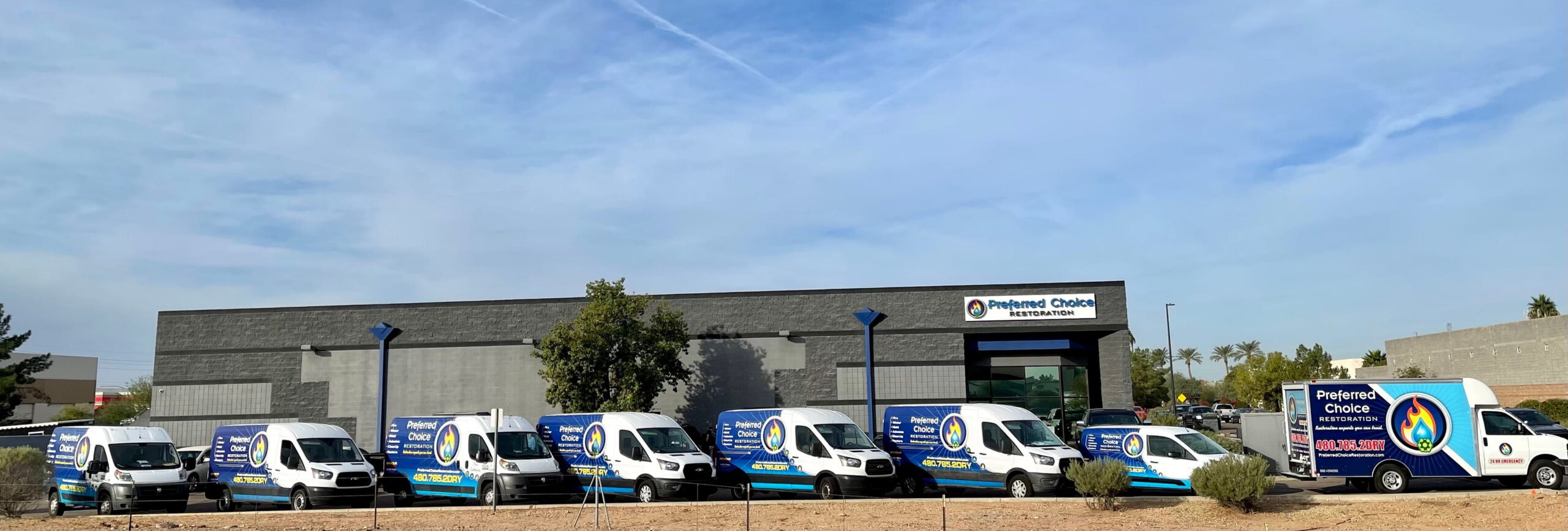
Have Damage at Your Property? Call Preferred Choice
We answer 24/7. Call for emergency help with water or fire damage, or to schedule a free estimate for mold, asbestos, or repairs.